
Purpose. Recovery. Independence. Vocational Rehabilitation Changes Lives.
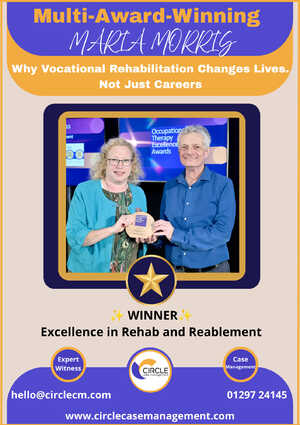
Multi-Award-Winning Maria Morris: Why Vocational Rehabilitation Changes Lives, Not Just Careers
Winning awards is always something to celebrate. But when those awards recognise work that transforms lives, restores independence and protects futures, they represent something much bigger.
Everyone at Circle Case Management is incredibly proud to congratulate Maria Morris on winning the Occupational Therapy Excellence Award for Excellence in Rehab and Reablement, adding yet another prestigious accolade to an already remarkable career.
This latest achievement follows Maria being named Vocational Rehabilitation Advisor of the Year, further cementing her reputation as one of the UK's most experienced and highly recognised Vocational Rehabilitation Case Managers and Expert Witnesses.
But for Maria, the awards have never been the goal.
The real success stories are the people who believed their working life was over, only to rediscover confidence, purpose and independence through vocational rehabilitation.
Work is About More Than a Pay Cheque
When someone's life changes following a catastrophic injury, clinical negligence, illness, disability, employment dispute or even relationship breakdown, work is often one of the first things they lose.
Alongside income comes the loss of routine.
Identity.
Confidence.
Social interaction.
Purpose.
At Circle Case Management, we recently began celebrating our tenth birthday with an inspiring talk from Meg Ginsberg, who shared her own rehabilitation journey.
One message resonated throughout the room.
Employment gave her structure. It gave her purpose. It gave her something to get up for each morning.
Her story perfectly reflected what vocational rehabilitation strives to achieve every day.
Returning someone to meaningful work isn't simply about employment.
It's about helping someone rebuild their life.
Saving Money. Saving Skills. Saving Futures.
Vocational rehabilitation is still introduced far too late in many personal injury and clinical negligence cases.
By the time vocational input is considered, valuable opportunities may already have been lost.
Early intervention can:
-
preserve employability and transferable skills
-
protect future earning capacity
-
reduce long-term financial losses
-
improve rehabilitation outcomes
-
increase confidence and independence
-
reduce social isolation
-
support sustainable return to work.
For solicitors, insurers and rehabilitation professionals, vocational rehabilitation is not simply another rehabilitation service.
It is often one of the most cost-effective interventions available.
The right vocational strategy can reduce future loss of earnings, inform realistic schedules of loss and improve long-term outcomes for everyone involved.
Why Maria Morris?
With more than three decades of Occupational Therapy experience, Maria combines clinical expertise with vocational rehabilitation, ergonomics, functional capacity evaluation and expert witness practice.
Her work spans some of the most complex cases involving:
-
acquired brain injury
-
chronic pain
-
PTSD
-
neurological conditions
-
severe mental health
-
autism and learning disability
-
catastrophic orthopaedic injury.
Her approach extends far beyond assessment.
Maria negotiates directly with employers, develops phased return-to-work programmes, recommends workplace adjustments, explores retraining opportunities and supports career redirection where returning to previous employment is no longer realistic.
She also provides robust, evidence-based vocational expert witness reports across personal injury, clinical negligence, employment and family proceedings.
Her work regularly demonstrates that meaningful employment is achievable even after life-changing injury—challenging outdated assumptions that work is no longer possible.
Award-Winning Practice Backed by Real Outcomes
Maria's recent Occupational Therapy Excellence Award recognised her transformational approach to vocational rehabilitation and reablement.
Her nomination highlighted measurable outcomes including:
-
successful long-term return-to-work programmes
-
reduced dependency on care
-
improved psychological wellbeing
-
restored confidence and identity
-
reduced long-term loss of earnings
-
sustainable workplace adjustments
-
influential vocational expert evidence supporting litigation.
Clients consistently describe feeling listened to, understood and believed.
Solicitors value her balanced, evidence-based opinions and practical recommendations that stand up to scrutiny.
Most importantly, clients leave with something many feared they had lost forever:
Hope.
Vocational Rehabilitation is an Investment, Not a Cost
Whether instructed following personal injury, clinical negligence, employment disputes or family proceedings, vocational rehabilitation should never be viewed as an optional extra.
Done early, it protects futures.
It preserves skills.
It reduces financial losses.
And, perhaps most importantly, it restores purpose.
At Circle Case Management, we believe rehabilitation is about helping people live meaningful lives—not simply managing disability.
Maria Morris embodies that philosophy every day.
Her latest award is a recognition of clinical excellence, but the greatest measure of success will always be the people whose futures have been transformed through meaningful work.
If you're looking for an experienced Vocational Rehabilitation Case Manager or Expert Witness, why wouldn't you instruct one of the UK's most highly awarded specialists?
To discuss instructing Maria Morris, contact Circle Case Management on 01297 24145 or email expert@circlecm.com.
Posted by Nicola Kelly on July 14th 2026
 Updating page...