

Beyond the Diagnosis: The Overlooked Impact of Visual Impairment in Expert Witness Assessments
Beyond the Diagnosis: The Overlooked Impact of Visual Impairment in Expert Witness Assessments
Visual impairment can affect almost every aspect of a person's life. Yet when it comes to personal injury and clinical negligence claims, are we always looking beyond the medical diagnosis to understand the full extent of its impact?
For solicitors dealing with claims involving sight loss, understanding the nature and severity of a visual impairment is an important starting point. However, clinical findings alone may not adequately explain how an individual's condition affects their independence, employment prospects, earning capacity and participation in everyday life.
Two individuals with similar diagnoses may experience very different functional limitations, require different levels of support and have significantly different rehabilitation outcomes.
This is where specialist functional and vocational expert evidence can add considerable value.
At Circle Case Management, Maria Morris, Senior Expert Witness and Vocational Rehabilitation Case Manager, has specialist experience in visual impairment and understands the importance of considering not only what an individual may have lost, but also what they can realistically achieve with appropriate rehabilitation, adjustments and support.
Understanding Sight Loss Beyond the Clinical Findings
Visual impairment is not a single, uniform experience.
The impact of sight loss depends on numerous factors, including the nature of the condition, the degree and pattern of vision loss, the individual's age, previous level of functioning, additional health conditions and personal circumstances.
For example, an individual may retain relatively good central vision but experience significant peripheral field loss, making navigation and mobility particularly challenging.
Another person may have reduced visual acuity, affecting their ability to read, recognise faces or undertake detailed tasks.
Others may experience difficulties with contrast sensitivity, depth perception, light sensitivity or adapting to changes in lighting.
The functional consequences can vary considerably.
Importantly, visual acuity alone does not provide a complete picture of someone's functional abilities.
An ophthalmologist or other appropriately qualified medical expert may establish the diagnosis, causation and prognosis. However, additional specialist assessment may be required to understand the practical implications of that condition.
Questions that may need exploring include:
- How does the impairment affect everyday activities and independent living?
- Can the individual navigate familiar and unfamiliar environments safely?
- What difficulties arise when reading, using technology or processing visual information?
- How has the condition affected education, employment or career progression?
- What rehabilitation, assistive technology or environmental adjustments could improve functioning?
- What support is currently required, and what might reasonably be needed in the future?
These questions can be particularly relevant when assessing long-term rehabilitation needs and the extent of financial and non-financial losses.
The Impact on Employment and Earning Capacity
One area that may be overlooked is the impact of visual impairment on an individual's future employment prospects.
A person may be medically considered capable of working, but this does not necessarily mean they can return to their previous occupation, maintain the same working hours or achieve their anticipated career progression.
Consider someone whose occupation requires driving, precision work, reading complex information or navigating unfamiliar environments.
Even a relatively specific visual limitation may substantially affect their ability to perform particular duties.
For another individual, the same impairment may have a considerably smaller vocational impact because their role can be adapted through accessible technology, workplace modifications or changes in working practices.
A specialist vocational assessment can help examine:
Pre-injury employment and career trajectory
What was the individual doing before the injury or onset of their condition? What qualifications, experience, transferable skills and realistic career progression opportunities did they have?
Current functional and vocational abilities
Which aspects of their previous role remain achievable? What restrictions exist, and how do these affect their ability to work safely, effectively and consistently?
Reasonable workplace adjustments
Could assistive technology, altered duties, modified working arrangements or environmental adaptations enable a return to employment?
Retraining and alternative employment
Where a return to the previous occupation is no longer realistic, what alternative roles might be suitable? Would additional qualifications, training or specialist support be required?
Long-term earning capacity
What is the individual's realistic employment outlook, considering their abilities, restrictions, experience, support needs and the availability of suitable opportunities?
These considerations are particularly important when examining claims involving loss of earnings, reduced earning capacity and future employment disadvantage.
A well-reasoned vocational opinion should consider both the barriers created by visual impairment and the realistic opportunities available to overcome them.
Reasonable Adjustments: What Is Actually Possible?
The Equality Act 2010 provides important protections for disabled employees and job applicants, including duties to make reasonable adjustments where applicable.
However, assumptions about what adjustments are available, effective or reasonable can result in an incomplete understanding of someone's employment prospects.
Not every adjustment is expensive or complicated.
Depending on the individual's needs and occupational requirements, adjustments might include:
- Screen-reading or magnification software.
- Larger monitors, accessible displays or specialist lighting.
- Changes to workplace layouts and navigation.
- Accessible documents and alternative communication formats.
- Flexible working arrangements or adjustments to working hours.
- Modifications to specific tasks or responsibilities.
- Training, retraining or additional workplace support.
The question is not simply whether adjustments exist.
It is whether the proposed adjustments are appropriate, effective and realistically achievable for that particular individual and workplace.
An individual may be able to perform certain tasks using assistive technology but still experience significant fatigue, reduced efficiency or difficulties when working within demanding time constraints.
Equally, assumptions that sight loss automatically prevents employment may underestimate an individual's abilities and rehabilitation potential.
Expert vocational evidence can help distinguish between theoretical possibilities and realistic, sustainable employment outcomes.
Daily Living, Independence and the Wider Impact of Sight Loss
The implications of visual impairment frequently extend beyond employment.
Depending on the nature and severity of the condition, individuals may experience difficulties with:
- Preparing meals and undertaking household activities.
- Shopping, managing finances and accessing written information.
- Using public transport and travelling independently.
- Managing medication and healthcare appointments.
- Accessing education, leisure activities and community services.
- Caring for children or supporting family members.
- Maintaining confidence and participation in social activities.
Some difficulties may be addressed through rehabilitation, equipment, environmental modifications or additional training.
Others may require ongoing assistance.
Importantly, the level of support required may change over time as individuals develop new skills, adapt to their condition or experience changes in their health.
For solicitors assessing care, assistance and rehabilitation claims, understanding this distinction can be important.
An assessment should consider the individual's actual needs, the support already available and the extent to which specialist intervention could improve independence.
It should also distinguish between the individual's needs arising from the relevant injury or condition and those attributable to other circumstances, where the evidence allows.
Assistive Technology: A Valuable Tool, but Not a Universal Solution
Developments in assistive technology have created substantial opportunities for people living with visual impairment.
Screen readers, electronic magnifiers, accessible smartphones, voice-controlled devices and specialist software can help people access information, communicate, undertake everyday tasks and participate in employment.
However, identifying a piece of equipment is not the same as establishing that it will meet someone's needs.
An effective assessment may need to consider:
- Whether the technology is suitable for the individual's particular visual impairment.
- The person's confidence, experience and ability to use it.
- Training and ongoing technical support requirements.
- Compatibility with workplace systems and other equipment.
- The practical benefits and limitations of the technology.
- The cost of equipment, maintenance, replacement and future upgrades.
For example, magnification software may be highly effective for one individual but less appropriate for another who experiences a different pattern of sight loss.
Similarly, assistive technology may enable someone to perform individual tasks without necessarily making a demanding full-time role sustainable.
The focus must remain on the individual rather than the technology itself.
Why Specialist Knowledge and Lived Experience Matter
Understanding the functional consequences of visual impairment requires more than familiarity with medical terminology.
It also involves recognising the practical barriers people encounter and the resources available to support greater independence.
Recently, Maria Morris visited Southampton Sight, an independent charity that has supported blind and partially sighted people for more than 125 years.
The visit provided an opportunity to refresh and further develop her specialist knowledge of visual impairment, including the practical challenges associated with sight loss and the support available through community-based services.
Southampton Sight offers a range of resources, including assistive technology, independent living support, emotional wellbeing services and opportunities for social participation.
Its user-led approach is particularly valuable, with people who have lived experience of visual impairment helping to shape and deliver services.
For professionals undertaking expert witness and vocational assessments, engagement with organisations such as Southampton Sight can provide useful insight into the real-world application of rehabilitation strategies and assistive technology.
It can also help professionals remain informed about community resources that may be relevant to an individual's rehabilitation.
Expert knowledge should not remain static.
As rehabilitation approaches, technologies and opportunities evolve, continuing professional development helps ensure that opinions remain informed, balanced and relevant.
Young People, Education and Future Vocational Opportunities
Visual impairment can also have significant implications for children and young people as they transition towards adulthood.
Where sight loss results from an injury or clinical negligence, consideration may need to extend beyond immediate educational requirements to future independence, training and employment prospects.
A young person may have the academic ability and ambition to pursue further education or a particular career but encounter additional barriers to accessing those opportunities.
These might include navigating unfamiliar educational environments, accessing learning materials, travelling independently, obtaining work experience or developing confidence in communicating support needs.
The assessment of future vocational potential may therefore require consideration of:
- Educational attainment and anticipated progression.
- Career interests and realistic occupational pathways.
- Accessibility of further and higher education.
- Opportunities to develop independent living and travel skills.
- Assistive technology and specialist educational support.
- Barriers to work experience, employment and vocational training.
- The potential impact on long-term employment and earning capacity.
An important consideration is whether the individual has had sufficient opportunities and support to develop their abilities.
A lack of previous experience should not automatically be interpreted as a lack of potential.
For example, Southampton Sight's developing VisionWorks programme, aimed at young people aged 16–25 with sight loss, recognises the importance of building confidence, independence, self-advocacy and opportunities during the transition into adulthood.
Such initiatives demonstrate why future vocational outcomes should be considered within the wider context of accessibility, rehabilitation and the opportunities available to each person.
When Should Solicitors Consider Specialist Vocational Expert Evidence?
In personal injury and clinical negligence litigation, early consideration of vocational issues may help identify relevant evidence and clarify whether specialist assessment is required.
A vocational expert may be particularly valuable where:
- A claimant's visual impairment affects their ability to return to their previous occupation.
- There is uncertainty about future employment prospects or earning capacity.
- Reasonable adjustments and alternative employment options need to be explored.
- The individual requires vocational retraining or specialist employment support.
- A young person's future educational or occupational opportunities may be affected.
- There is disagreement about the extent to which visual impairment limits work capacity.
- The potential benefits and limitations of rehabilitation or assistive technology require specialist consideration.
For some cases, expert evidence from several disciplines may be appropriate.
An ophthalmologist may address the medical condition and prognosis, while an occupational therapist, vision rehabilitation specialist or vocational expert may examine particular aspects of function, rehabilitation or employment.
Each expert should remain within their own professional competence, with the instruction carefully matched to the issues requiring an opinion.
Under Civil Procedure Rules Part 35, expert evidence must be independent and directed towards assisting the court.
A robust assessment should therefore consider both favourable and unfavourable evidence, explain any limitations and distinguish between established findings, reasonable assumptions and matters that remain uncertain.
The objective is not to maximise or minimise a claim.
It is to provide a balanced, evidence-based opinion that helps the court understand the individual's circumstances and realistic future needs or prospects.
Looking Beyond the Diagnosis to Understand the Individual
Visual impairment does not affect everyone in the same way.
The diagnosis may explain the medical condition, but it does not necessarily reveal the full impact on someone's employment, independence, confidence or future opportunities.
Nor does it determine the extent to which rehabilitation, assistive technology and reasonable adjustments could make a difference.
For solicitors working with clients who have experienced sight loss, specialist functional and vocational evidence can help develop a clearer understanding of these issues.
At Circle Case Management, Maria Morris combines her vocational rehabilitation and expert witness experience with a commitment to maintaining and developing her specialist knowledge of visual impairment.
Her recent visit to Southampton Sight reflects the importance of learning from organisations that work directly with people affected by sight loss and understand the everyday realities behind the clinical terminology.
Because when assessing the consequences of visual impairment, the most important question is not simply what someone can no longer see, but how their condition affects the life they want and are realistically able to lead.
Specialist Vocational Rehabilitation and Expert Witness Services
Circle Case Management provides independent expert witness and vocational rehabilitation services for solicitors working across personal injury, clinical negligence and other areas of litigation.
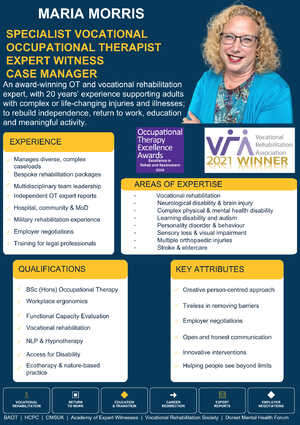
Maria Morris – Senior Expert Witness and Vocational Rehabilitation Case Manager
Maria has specialist experience in visual impairment and can provide vocational expertise where injury, illness or disability affects an individual's employment, rehabilitation and future opportunities.
To request Maria’s C.V, or discuss your requirements please Email: expert@circlecm.com or Call: 01297 24145
Circle Case Management
Website: www.circlecasemanagement.com
Circle Case Management – Supporting rehabilitation, independence and informed decision-making.
Posted by Nicola Kelly on November 12th 2026
 Updating page...